

The Way Organizations Interact with Knowledge Is Changing
For years, reports have helped organizations collect and share knowledge. They are widely used in research, market intelligence, product development, and regulatory analysis.
However, today’s business environment is changing rapidly. Data is growing faster, research is becoming more complex, and teams are expected to make decisions more quickly.
As a result, traditional reports are no longer enough.
Reports still provide valuable insights, but they capture information at a single point in time. They cannot adapt when new questions arise or when fresh information becomes available.
Companies are now building smarter research systems that use the same data but look at it from every angle, letting team explore freely, spot future trends, and get reference-backed answers rather than a single static narrative.
Human expertise remains at the centre of this process, giving the system’s output the judgment and direction that data alone cannot provide.
Organizations are now moving toward connected knowledge systems that allow teams to explore information from multiple angles, uncover trends, and find reference-backed answers while still relying on human expertise for judgment and decision-making.
Why Static Reports No Longer Support Modern Research
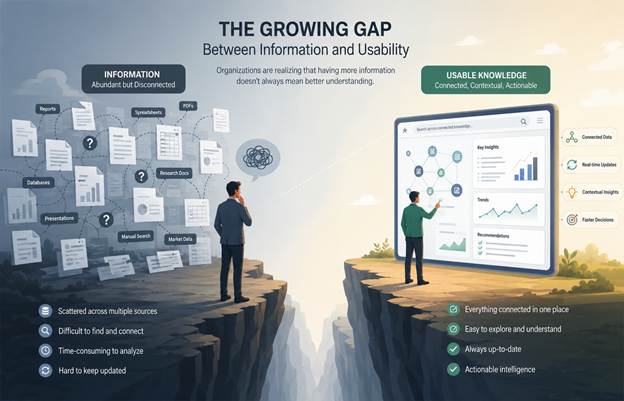
In many industries today, teams work across a combination of PDFs, dashboards, spreadsheets, presentations, and research documents. While these formats help organize information, they often create limitations when deeper exploration becomes necessary.
Consider a strategy of team monitoring developments in the cosmetic industry.
A report may include:
-
Competitor launches
-
Formulation trends
-
Pricing movements
-
Ingredient innovations
-
Consumer preferences
First, the information appears structured and useful. However, new questions usually emerge after the report has already been created.
For example:
-
- Which competitors would be going into next gen ingredients?
-
How could trends change across regions?
-
Are there related patent filings connected to some specific formulations?
-
Could any regulations impact product categories in coming future?
Unlike a static document that confines the reader to a single authored perspective, these research systems invite active exploration – enabling users to see the dimensions of the data that no individual analyst could have fully mapped within the constraints of a conventional report.
Reading Information Is No Longer Enough
Modern teams need more than access to information. They need to understand how different pieces of knowledge connect.
For example, an R&D team may need to review:
-
- Scientific literature
-
Formulation data
-
Supplier specifications
-
Patent information
- Regulatory updates
Although this information exists, it is often spread across multiple systems.
As a result, researchers spend significant time:
-
- Searching across sources
-
Checking credibility
-
Comparing data
-
Organizing fragmented information
In many cases, insight generation begins only after extensive preparation.
A static document cannot easily adapt to these evolving layers of exploration.
Consequently, organizations are beginning to shift away from simply storing information toward creating systems that support continuous interaction with knowledge.
The Shift Toward Interactive Knowledge Systems
Organizations are increasingly exploring living knowledge systems.
Unlike traditional reports, these systems are not fixed documents. They allow information to be explored, connected, and updated as needs evolve.
For example, a market intelligence team studying functional beverages could explore consumer trends, ingredient developments, startup activity, pricing changes, and regulations within a connected environment rather than across multiple reports.
The goal is not simply faster access to information. It is to create a clearer understanding of how different insights relate to one another.
How Research Workflows Are Evolving
| Traditional Approach | Modern Expectation |
| Static reports | Interactive knowledge |
| Manual searching | Faster access to connected insights |
| Disconnected information | Context-rich understanding |
| Periodic updates | Continuously updated intelligence |
| Fixed exploration | Question-driven exploration |
| Time-consuming analysis | Faster decision-making |
How Living Knowledge Systems Could Improve Research Workflows
The shift toward interactive knowledge systems could significantly improve how organizations discover, interpret, and apply insights across different workflows. Instead of spending large amounts of time navigating disconnected information, teams could focus more on understanding relationships, identifying patterns, and making informed decisions faster.
Different functions across organizations could benefit in different ways:
-
-
Market intelligence teams could track competitor activity, and emerging trend signals more dynamically.
-
R&D teams could explore formulations, scientific findings, and product relationships within a more connected research environment.
-
Procurement and supply teams could gain better visibility into supplier networks, sourcing dependencies, and sustainability considerations without manually compiling fragmented information.
-
Regulatory teams could monitor evolving compliance requirements while understanding how those changes impact products, markets, and operational workflows together.
In each of these situations, the real value does not come only from having access to more information. Instead, it comes from improving how knowledge is connected, explored, and understood within a broader context.
As organizations continue generating larger volumes of data, the ability to interact with information more intelligently may become increasingly important for faster and more effective decision-making.
Looking Ahead
Reports will remain important for documenting findings and sharing conclusions. However, static documents alone cannot keep pace with rapidly changing research environments.
Markets evolve. Regulations change. Competitors are launching new products. Consumer preferences shift.
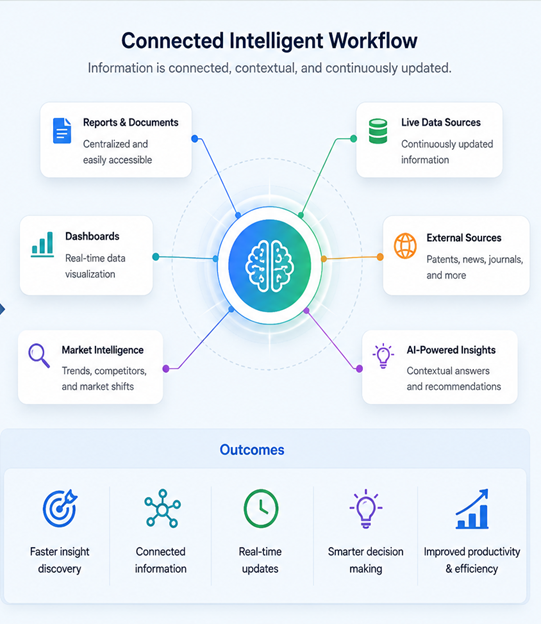
Organizations increasingly need systems that support:
-
-
Continuous exploration
-
Contextual understanding
-
Connected knowledge
-
Evolving workflows
The future of research may involve not only reading reports but also interacting with living knowledge systems that make information easier to access, connect, and apply.
Explore how RESGPT.AI is helping organizations move beyond static research workflows toward more connected and interactive knowledge experiences.
Curious how connected research intelligence can transform innovation workflows? Let’s explore the possibilities together.